

Digitalization of the construction industry:
driving productivity
Find out more about this key topic at BAU 2027. The world’s leading trade fair for architecture, materials and systems took place in Munich from January 11–15, 2027.

Key points at a glance
- Productivity gap as a driver: Construction is one of the least productive sectors worldwide. Digitalization is the structural response to growing pressure on efficiency and costs.
- Technology is ready—the framework is lagging behind: From generative design and digital twins to smart building infrastructure, the necessary tools already exist. What’s missing is expertise, integration, and digital approval processes.
- The transformation is in full swing: At BAU 2027, planners, contractors, and technology providers will demonstrate how they are working together to drive the digital transformation of the construction industry.
The construction industry faces the most profound transformation in decades. Artificial intelligence automates planning processes, and building operation can be controlled thanks to digital twins—and federated data infrastructures connect both. According to the RICS Construction Productivity Report 2026, global construction productivity grew by just 0.4 percent annually between 2000 and 2022, although construction spending is projected to rise from USD 13 trillion to USD 22 trillion by 2040. Digitalization is the structural response to growing pressure on efficiency and costs. Experience at BAU 2027 how technologies—from generative design and AI to digital process acceleration—will redefine the construction industry.
What does digitalization mean in construction?
Digitalization in construction means more than just replacing paper with software. Instead, it describes the creation of a seamless data continuum, from the initial planning and construction to building operation and dismantling.

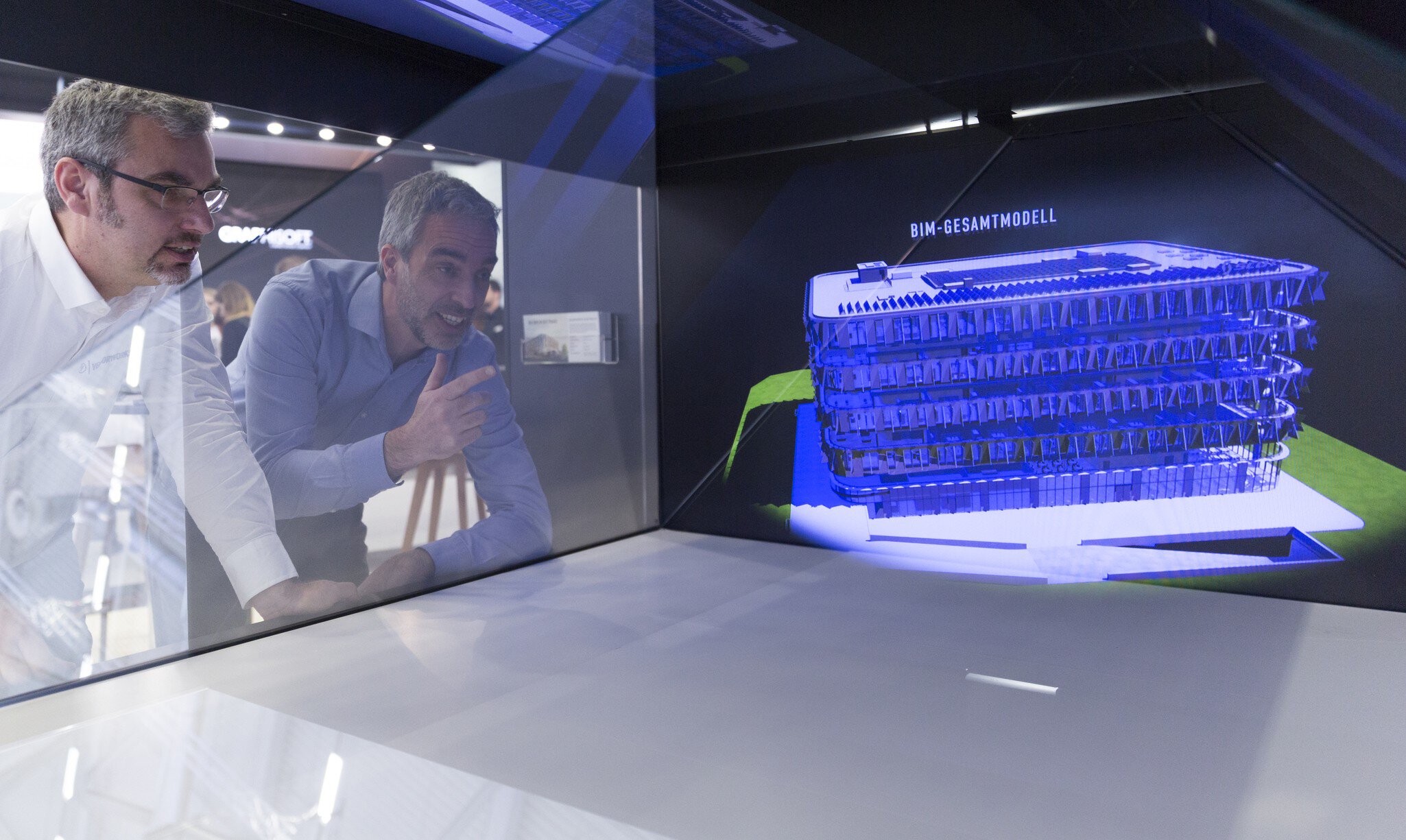
At its core, the aim is to make it possible to use data consistently across project phases, disciplines, and company boundaries. Building Information Modeling (BIM) serves as the methodological basis. A shared digital model replaces the fragmented exchange of information across project phases and disciplinary boundaries.
The digital twin extends this concept to operations. The building remains permanently linked to its data model and is continuously updated with sensor data from the Internet of Things (IoT). AI-powered systems detect collisions in the model before construction begins. Predictive maintenance reduces unplanned downtime. Cloud-based platforms enable location-independent collaboration. The main challenge here is not a lack of technology, but integration.
Opportunities and challenges of the digital transformation
Benefits of the digitalization of the construction industry:
- Radically reduce defect costs: Virtual Design & Construction reduces defects by up to 73 percent compared to traditional methods. Collisions are detected before ground is even broken—all stakeholders work in real time using a shared database.
- Measurably manage the carbon footprint: Digital tools enable integrated carbon accounting as early as the design phase. Today, 60 percent of construction experts use digital tools to measure gray emissions—up from 40 percent in 2023 (NBS 2025).
- AI creates measurable economic value added: 73 percent of AEC companies still do not use AI in any phase of their projects. However, those who do use it consistently report measurable savings in time and costs and want to expand their use of it (Bluebeam 2025).
Essential challenges of the digitalization of the construction industry:
- Technology without know-how is wasted: 82 percent of German construction companies lack the necessary knowledge, but at the same time less than ten percent of their technology budget is allocated to training. Investments without qualifications are wasted (PwC/Bluebeam 2025).
- System silos make digital transformation a piecemeal effort: 23 percent of respondents cite integration complexity as the biggest single obstacle—even ahead of costs or a lack of leadership support. As long as data is lost at the boundaries between phases, digitalization will remain a siloed solution (Bluebeam 2025).
- Analog procedures slowing down the digital transformation: 80 percent of companies cite analog approval procedures as a specific obstacle. Only 17 percent report that customers are actively demanding digital solutions (PwC 2025).
The gap between recognizing potential and actual implementation is widening—by 48 percentage points for AI within a single year (PwC, 2025). The gap with early adopters is growing—and growing fast.
What is the current situation regarding digitalization in the construction industry?
The construction industry is one of the least productive sectors worldwide. Between 2000 and 2022, productivity in this sector grew by just 0.4 percent annually, while overall economic growth was around 2 percent (RICS 2026). The gap with the automotive industry or mechanical engineering continues to widen.
There is a familiar pattern behind this. 66 percent of German construction companies see great potential in AI, yet nowhere is the gap between recognizing potential and actual expertise greater (PwC 2025). Only 11 percent work completely digitally today (Bluebeam, 2025). According to RICS, global construction spending is projected to rise from USD 13 trillion (in 2023) to USD 22 trillion by 2040.
Without a leap in productivity, this growth cannot be managed—and that requires more than just technology: 93 percent of companies are calling for reduced bureaucracy and a digital infrastructure (PwC 2025). However, data sovereignty and speeding up approval and standardization procedures are still particularly critical issues.
Data, product passports, and digital ecosystems
As long as project data remains in proprietary silos, collaboration throughout the entire building life cycle will remain fragmented. This is where federated infrastructures such as GAIA-Xto come in. The data remains under the control of the respective owners but can be accessed in an interoperable manner by all the stakeholders, from planning to dismantling.
The digital product passport closes the final gap at the material level. The origin, composition, carbon footprint, and recyclability of each construction product are permanently documented in a machine-readable format. Only then can circular construction be verified and implemented.
Sustainability certifications such as DGNB, LEED, or BREEAM can now be automated for the first time using digital databases—manual documentation is no longer needed when product passport data is incorporated directly into certification models.
A shadow carbon price puts an internal price on the environmental costs of building materials, creates incentives for lower-emission decisions, and makes climate targets visible in cost accounting.
Digital building permission and simplification of standards
While Estonia, the Netherlands, and Finland now approve construction projects completely digitally, this is still the exception in Germany. BIM-based verification routines automate compliance checks and reduce approval times from months to weeks. The same applies on a larger scale. The automotive industry and shipbuilding have shown how consistent standardization and functional tendering can shorten innovation cycles.

Anyone who wants to bring new materials like bio-based insulation or recycled concrete components to market faster needs testing processes that keep up with the pace of innovation. Digital tools also play an underestimated role in recruiting young talent in skilled trades. Augmented reality applications in training, digital work planning, and modern construction site technology make skilled trades more appealing to a tech-savvy generation and lower the barrier to entry for career starters.
Trends in the construction industry—digitalization in construction
Digitalization alters the logic of the entire construction process. An overview of the most influential developments:
Building Information Modeling has evolved from a visualization method into a process-related basis. Today, 72 percent of construction experts actively use BIM, and 88 percent are already using it or planning to implement it (NBS 2025). The next step is to apply it to existing buildings: Digital planning tools for existing buildings, combined with point cloud scans and AI-powered inventory of existing building stock, make it possible for the first time to plan large-scale, serial renovations. Architected structures go beyond traditional structural engineering: Computer-aided optimization methods develop structures that combine lightness, strength, and functionality.
Today, AI automates routine tasks such as quantity takeoff, collision detection, and scheduling. The next level is generative design: Algorithms use defined parameters—structural analysis, material usage, carbon footprint, and costs—to independently develop design variants and optimize them iteratively. Process mining analyzes actual construction processes for inefficiencies and derives potential for standardization from it. Text-to-image models translate planning parameters into photorealistic visualizations and significantly speed up the coordination process with developers. AI-powered material databases link product data with carbon footprints, costs, and availability, enabling a data-based comparison of planning decisions for the first time. In the Morgenstadt project, the Fraunhofer Institute demonstrates how AI-powered urban planning integrates energy, mobility, and building data to derive optimization scenarios for urban neighborhoods.
Circular construction benefits directly from AI: Algorithms analyze material flows, identify potential for dismantling and reuse as early as the design phase, and optimize component configurations to maximize recyclability.
Today, the smart building is more than just building automation. Smart buildings integrate energy generation, storage, and distribution into a connected system—extending beyond the individual building into local microgrids and smart grids. Decentralized photovoltaics, battery storage, and bidirectional grid connection turn buildings into active participants in the energy supply. IoT sensors provide the database for predictive maintenance, energy optimization, and user comfort in real time. Smart home is the extension of building automation into the private living space. Heating, lighting, security, and energy management can be controlled individually by users and integrated into higher-level smart grid systems via interfaces.
Today, the construction site is the least digitized part of the construction process, even though it offers the greatest leverage. Digital construction site management platforms connect progress tracking, materials logistics, and quality assurance in real time. Drones look after surveying, inspection, and progress documentation—more accurately and faster than manual processes. Wearables record the workforce’s safety data. A 5G infrastructure provides the connectivity basis for all these applications.
41 percent of workers in the construction industry are expected to retire by 2031—while the construction volume continues to grow. Autonomous systems perform repetitive tasks such as masonry work, concreting, and rebar installation. This does not replace jobs, but instead fills a demographic gap that cannot be filled in any other way.
Additive manufacturing processes enable component-specific production with minimum material waste, from concrete printing processes in residential construction to complex facade elements. Smart materials go a step further: Materials that respond to environmental stimuli, generate energy, or adaptively change their structural states substantially expand the design scope.
Serial and modular construction applies manufacturing logic from industry and car manufacturing to building construction. Standardized building systems and prefabricated modules shorten construction times and make quality reproducible—regardless of the availability of large construction crews. In the field of renovation, serial renovation using prefabricated facade modules, which can be installed within a day, enables the industrial-scale modernization of existing buildings for the first time.
FAQs
The term describes the creation of a seamless data continuum, from the initial planning and construction to building operation and dismantling. The methodological basis comprises BIM (Building Information Modeling) and the digital twin, supplemented by AI (Artificial Intelligence), IoT (Internet of Things), and connected data infrastructures.
At its core, the aim is to make it possible to use data consistently across project phases, disciplines, and company boundaries.
The industry is undergoing a radical transformation: Although the technology tools are available, they have yet to be used across the board. By international standards, Germany is one of the more developed markets.
A lack of expertise, system gaps between proprietary software solutions, and analog approval procedures are slowing down the transformation—not so much the technology itself, but rather the general conditions.
BIM has become the standard method. The focus is increasingly shifting from 3D visualization to process-related methods, so that BIM is used as a shared database throughout the entire building life cycle.
Virtual Design & Construction significantly reduces planning errors and reworking. AI, robotics, and the digital construction site unlock additional potential for productivity, sustainability, and securing skilled worker.
References
- PwC Deutschland: Die Bauindustrie weiter im Umbruch, Februar 2025
- RICS: Construction Productivity Report 2026, März 2026
- NBS / Hubexo: Digital Construction Report 2025
- Bluebeam: Ausblick auf Technologie- und Digitalisierungstrends 2026, Oktober 2025
Your direct way to BAU 2027!
All it takes is a few clicks to purchase your personal ticket to BAU or to redeem a voucher.