

Changing Living Space—What does the future of housing look like?

Key points at a glance
- Housing for every stage of life: Accessibility, flexible floor plans, and cooperative models are not niche topics. They are essential for ensuring that neighborhoods are able to accommodate people in different life situations.
- Vacancies meet the housing shortage: Millions of vacant apartments and office buildings are waiting to be repurposed, while at the same time the housing shortage is considered a crisis. Capitalizing inventory represents the largest untapped reserve.
- Simpler construction, better living: Pilot projects in several European countries show that cost reduction and quality are not mutually exclusive—provided that standards and liability issues are redefined.
Housing is a fundamental issue. Not in an abstract sense—but in very practical terms: Where you live dictates which school your children attend, whether you can change jobs, and whether you can stay in the neighborhood you’re familiar with as you get older. Housing determines participation.
According to a 2025 study by the Pestel Institute, there is a shortage of approximately 1.2 million apartments in Germany alone. And yet millions of apartments and office spaces remain vacant. Young people can’t find a foothold in cities, while older people stay in apartments that have long since become too big because there’s nowhere suitable for them to move to. At the same time, there is a shortage of affordable, accessible, family-friendly housing—a situation that only exacerbates the problem. BAU 2027 brings together all those who want to make a difference.
Living on the Brink
The housing market is reshaping society. According to the study “Wohnungsbau 2025—Quo vadis?” (Residential Construction 2025 – What’s the situation?) by ARGE Kiel, something that was long considered a problem for low-income households has now escalated into a structural crisis. Large segments of the population can no longer find affordable housing.
The reasons for this are varied and intertwined: There is population growth driven by migration; households are getting smaller; there is overcrowding in certain areas; and, at the same time, an unequal distribution of housing is further exacerbating the situation. It’s a classic mismatch problem, and one that no market can solve on its own. This has consequences that extend far beyond the housing market.
According to the Pestel Institute, this has effectively brought the cross-regional balancing of labor markets to a standstill. Companies are unable to fill job openings because potential employees cannot find affordable housing at their destination. This problem is made worse by a cost spiral resulting from rising construction costs and changing financing conditions, which make new construction financially unfeasible for a large portion of the market.
On top of this, there is a structural paradox: The average living space per capita in Germany has risen by about 40 percent since 1991, which regularly offsets gains in construction efficiency. The industry rarely asks how much space is actually needed. In this context, sufficiency is not a reason to be frugal; it’s a planning challenge.
At the same time, construction activity is plummeting. The number of building permits has been declining for years. The ifo Institute warns that the capacity cuts in the construction industry cannot simply be reversed once the economy recovers. Businesses are closing, and skilled workers are leaving the industry. Restoring capacity takes much longer than reducing it—which has direct consequences for construction timelines, costs, and the industry’s ability to respond to rising demand.
Demographic change is further exacerbating the situation. Growing urban areas and shrinking rural counties present the construction industry with contrasting challenges and call for region-specific solutions.
Simple Construction: A New Standard
Anyone looking to make construction simpler and more affordable today faces structural limitations:
1. A regulatory framework that effectively penalizes deviations
2. Funding programs that, due to their complex requirements, take longer to produce results than necessary
3. A discrepancy between calculations and actual building operations.
Building Type E—Less Standardization, More Flexibility
At the end of 2023, the Bavarian State Ministry of Housing, Building, and Transport introduced Building Type E. This is not a new building category, but rather a regulated option to deviate from standards, allowing designers and building owners to mutually agree to diverge from technical standards without automatically being held liable. The legal basis is an amendment to Article 63 of the Bavarian Building Code.
Here’s what can be simplified:
- Type of heating
- Sound insulation standards
- Mandatory parking
- Accessibility requirements
- Insulation standards in accordance with the German Building Energy Act (GEG)
Anyone who deviates from these requirements has to make it clear to buyers and tenants that this is the new condition under which simplified construction becomes legally permissible. There are currently 19 pilot projects underway in Bavaria, which are being scientifically supported by the Technical University of Braunschweig. According to a key issues paper issued by the Federal Ministry of Justice and the Federal Ministry of Housing and Construction, Building, Type E is to be legally established nationwide through a Building Type E Agreement, which allows for deviations from the technical building codes of the federal states.
Hamburg Standard—Lower Construction Costs and Faster Processes
Hamburg is taking the same approach, but using different methods. The Bündnis für das Wohnen in Hamburg (Alliance for Housing in Hamburg) brings together 230 stakeholders from the housing sector, the construction industry, and regulatory agencies. Their goal is to save up to EUR 2,000 gross per square meter of living space in new construction. The savings are expected to come from three areas:
1. Approximately EUR 600 per square meter through adjusted standards in building construction and building services engineering, such as soundproofing, fire protection, accessibility, and the elimination of underground parking garage.
2. An additional EUR 400 through process optimization, involving shorter planning cycles, uniform standards, and digital tools.
3. Approximately EUR 1,000 due to faster approval processes on the part of the authorities.
While the focus for Building Type E is on simplification, the Hamburg Standard first defined specific cost targets and then developed strategies to achieve them. Currently, 30 construction projects are part of the initiative, 17 of which are located in the Wilhelmsburg Town Hall district, which serves as a model neighborhood.
Reduction Roadmap—Decarbonization as an Industry Commitment
While the approaches for Building Type E and the Hamburg Standard focus on standards and costs, the Danish Reduction Roadmap takes a different approach. It translates the goals of the Paris Agreement into concrete, scientifically validated sectoral targets for the construction industry. The Reduction Roadmap sets specific CO₂ targets for the construction industry that have been derived from the remaining global climate budget.
In 2022, the target was set at 0.4 kg of CO₂ per square meter per year by 2036; in 2023, it was tightened to 0.3 kg by 2030. More than 630 companies, municipalities, and organizations now support these targets politically and have called on the Danish legislature to incorporate them into the national building code.
With its 2024 report, “Beyond the Roadmap,” the initiative has broadened its horizons. Reducing CO₂ emissions is no longer enough on its own—the construction industry is to actively contribute to the restoration of natural ecosystems. The methodology has been deliberately designed to be applicable internationally. What has worked in Denmark as an industry-wide agreement can serve as a model elsewhere, provided that the stakeholders are willing to agree on common targets.
Serial and Modular Construction—A Means, Not an End in Itself
The terms “serial construction” and “modular construction” are often mentioned in the same breath, but they refer to different things. In modular construction, fully prefabricated room units are assembled on the construction site.
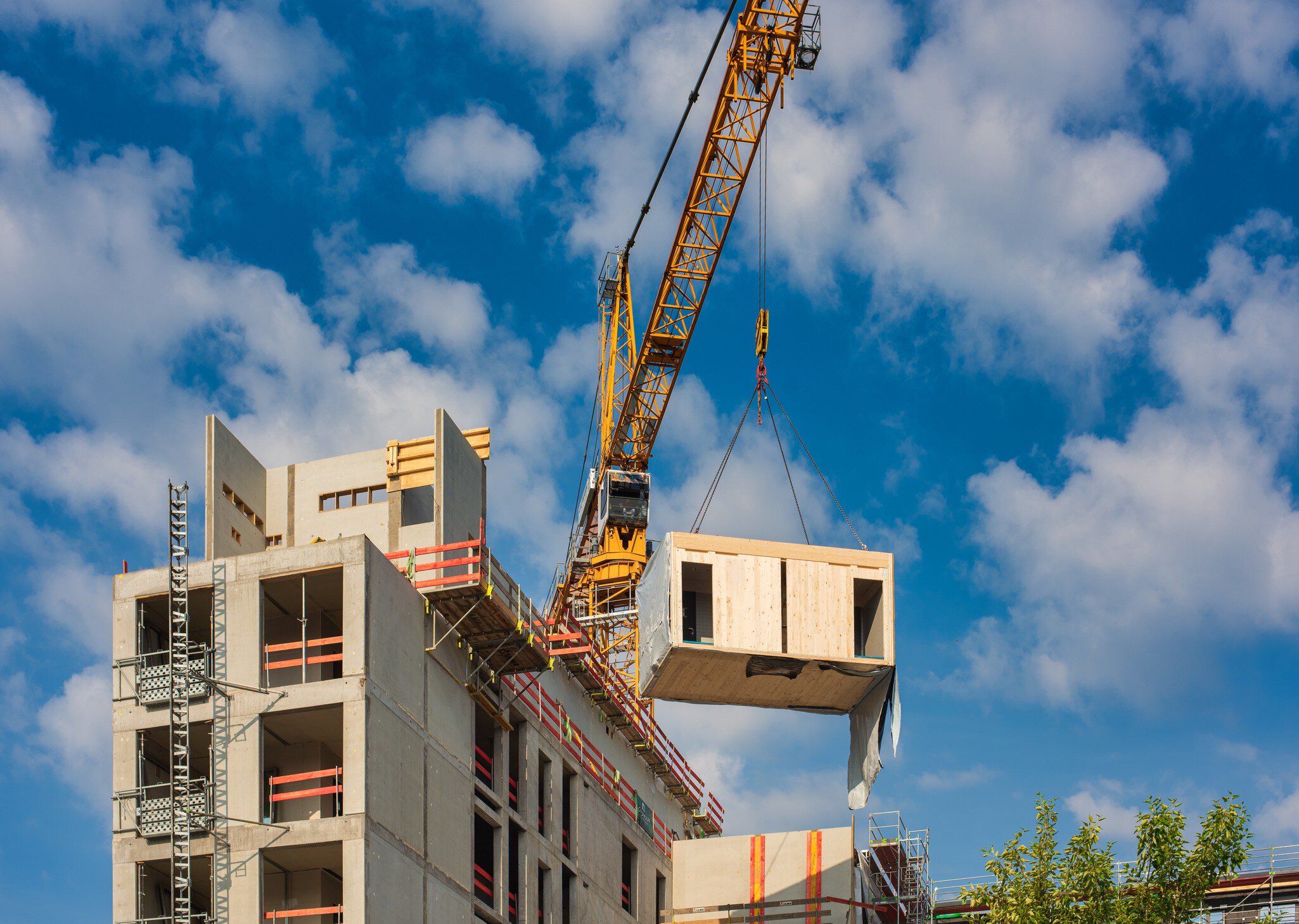
In contrast, serial construction focuses on the repeatability of elements and processes. This is useful for projects where speed is of the essence, such as student housing, employee housing, or building extensions. Standardized systems also have the advantage that components manufactured in series can often be disassembled by type.
Renovation Over New Construction: Existing Buildings as the Greatest Resource
According to the Deutschlandatlas, approximately 1.9 million apartments were vacant in Germany as of the survey date of May 15, 2022—that’s about 4.5% of the total housing stock. At the same time, the housing shortage is considered a crisis. This contradiction is present across Europe, in various forms. And everywhere, the obvious answer could be to make use of what’s already there before building something new.
In dense cities, adding levels to existing buildings and redensification within the existing built environment are often the only ways to create new housing without using up new land—be it vertically by adding additional stories, or horizontally by building extensions and filling in vacant lots. Both follow the same principle—inner development rather than expansion into greenfield areas. What makes these projects challenging is rarely the design itself—rather, it is structural integrity, cost-effectiveness, and the time required to obtain permits.
Working from home has transformed the office market across Europe. Many buildings that were designed to be fully occupied every day are now partially or completely vacant. Converting them into housing poses a technical challenge—the floor plans, natural lighting, and access were not designed with residential use in mind. But it can work, as demonstrated by projects in the Netherlands, the United Kingdom, and increasingly in Germany. In Germany, the federal government is now specifically promoting this conversion strategy through the “Gewerbe zu Wohnen” (Commercial to Residential) funding guidelines.
This often results in more than just housing. Old administration buildings are being transformed into mixed-use neighborhoods, and shopping centers are becoming places that house daycare centers, doctors’ offices, and local shops all under one roof. That is often the actual goal, rather than a side effect. The same principle applies to transportation infrastructure. As the number of cars in cities declines, parking garages are becoming a growing reserve of space that can be used for housing, commercial purposes, cultural activities, or urban production.
In the Netherlands, converting offices and church buildings into housing has been common practice for years. Through its “Zéro Artificialisation Nette”(Zero Net Artificialization) program, France is committed to the principle of not sealing any new land without restoring previously sealed areas to their natural state in return. The following projects serve as examples of the potential of the existing stock:
- ZIN, Brussels / Belgium (1972/2025): In Brussels, instead of demolishing two office towers from the 1970s, the firms 51N4E and l’AUC connected them with a linking structure to create a mixed-use building—featuring apartments, a hotel, and a public winter garden.
- Pong, Paris / France (1970/2024): In Paris, the architectural firms Calq and Bond Society have completely gutted a 1970s office building and converted it into coworking spaces and eight duplex shared living units based on the cluster principle. They were able to preserve over 80% of the structure.
- Thoravej 29, Copenhagen / Denmark (1967/2025): In Copenhagen, architect Søren Pihlmann has converted a simple 1960s building into a creative center by lowering concrete ceilings, integrating walls into floors, and repurposing suspended ceilings into columns and furniture.
- Battersea Power Station, London / UK (1933/2022): The London coal-fired power station on the Thames, which had fallen into ruin nearly 40 years after its decommissioning in 1983, has been converted by WilkinsonEyre into a mixed-use urban district—featuring apartments, an Apple campus, retail space, and a new subway station on the approximately 17-hectare site.
Housing for Every Stage of Life: Community, Inclusion, Participation
What gets built helps determine who can live where. That may sound trivial, but it has direct consequences: for older people who are stuck in apartments that are too large because there are no smaller options available in the neighborhood they are familiar with—according to the 2022 census, nearly 30 percent of one- and two-person households live in apartments of 100 square meters or more.
For families who have to move to the suburbs due to a lack of flexibility in floor plans and usage and for apprentices and students who can barely make ends meet in expensive cities. The construction and renovation of housing must therefore be viewed as a social responsibility.
- Older adults need accessible housing in familiar surroundings—elevators, accessible bathrooms, and adapted floor plans. Technically, this has been feasible for a long time. What is missing is the funding and the political pressure to implement it in existing buildings.
- Flexible floor plans that can be divided or combined help alleviate the lock-in effect, allowing older residents to downsize without having to move out and families to grow without relocating.
- Universal design means accessibility for everyone—for strollers as well as wheelchairs, for those with poor eyesight as well as those who struggle with disorientation. If this is planned from the start, it costs very little extra, while retrofitting will cost a lot.
- Cooperative housing stabilizes neighborhoods by curbing speculation. This has been standard practice in Vienna, Zurich, and Copenhagen for decades, and interest is growing in other European countries.
- Employee housing is experiencing a resurgence. Due to the shortage of skilled workers, companies are becoming developers—from hospitals that need to house nursing staff to small businesses that need apprentices. The WSK model in Cologne and the trainee campus in Fulda demonstrate what integrated neighborhood development can look like.
Livable Cities and Public Spaces: Places That Bring People Together
Urban development is about more than just housing construction. What holds a neighborhood together is what happens between the buildings. It’s the square where people sit; the library where people get together; the path to school, which is safe and shaded. If these elements are missing or in disrepair, even the most affordable new building is of little use.
Paris-based urban researcher Carlos Moreno has put a new spin on an old idea with the concept of the 15-minute city, whereby all the essential daily activities—work, shopping, school, medical care, and open spaces—should be accessible on foot or by bike. Under Mayor Anne Hidalgo, Paris has made this a guiding principle and has consistently aligned its urban planning, bicycle infrastructure, and ground-floor uses with it. The concept has now taken hold in cities across multiple continents.
Shaded areas and public drinking fountains are not a luxury. As heat waves become more frequent in European cities, they serve as a vital part of the healthcare infrastructure. The same applies to educational buildings and care facilities, which are often in a state of disrepair that does not reflect their importance to society. Investments in this area pay off in terms of the overall attractiveness of a neighborhood, for people of all ages.
After home and work, the third place is one where you can just be—without feeling pressured to buy anything, without any appointments. These are cafés, libraries, clubrooms, or parks, for example. These places don’t just pop up on their own. They need space, sponsors, and often seed funding.
Vacant department stores, abandoned administration buildings, and old barns offer space for this—provided that planning and financing are in place. Successful third places typically rely on a mix of funding sources: rental income, grants, food and beverage sales, and donations. What keeps them going in the long run is professional community management—someone who takes care of this area. But this is often underestimated in planning processes. For the construction industry, this means pursuing mixed-use development instead of functional segregation, setting up ground floors as active interfaces with the city, and making short distances a planning principle.
FAQs: Frequently Asked Questions
The lock-in effect refers to older people staying in large apartments because there are no smaller options available in the neighborhood they are familiar with and moving isn’t worth the trouble. At the same time, families lack space. The market cannot solve this problem on its own—it requires smaller, adaptable housing options within the existing housing stock and targeted incentives to encourage people to move.
In Germany, Building Type E allows designers and building owners to deviate from technical building codes by mutual agreement without automatically being held liable. Anyone who deviates from this must make that clear to buyers and tenants. This opens up possibilities for simpler, more affordable buildings—without compromising on good design.
The Hamburg Standard is a cost-reduction program for new housing construction, developed as part of the Bündnis für das Wohnen in Hamburg (Alliance for Housing in Hamburg) in collaboration with 230 stakeholders from the housing sector, the construction industry, and regulatory authorities. The goal is to save up to EUR 2,000 per square meter—through adjusted building standards, streamlined planning processes, and faster approval procedures.
The term was coined in the 1980s by the American sociologist Ray Oldenburg, who identified three types of places: home as the first place, the workplace as the second, and informal gathering spaces as the third place. They are cafés, libraries, community centers, and parks—places where people can simply hang out without feeling pressured to buy anything and without appointments. They are considered essential for social cohesion and function best where organizational leadership, funding, and active community management come together.
There is no single definition of this, but there are recurring characteristics. These include short distances to everyday amenities, safe and inviting public spaces, a mix of uses rather than a separation of functions, greenery and shade in the urban landscape, good connectivity without reliance on cars, and amenities for all age groups. The concept of the 15-minute city brings many of these elements together. This describes a city where work, shopping, education, healthcare, and leisure activities are all within walking or cycling distance.
Sufficiency refers to the conscious use of land and resources—not as a reason to be frugal, but as a planning challenge. Flexible floor plans, divisible apartments, and shared spaces are solutions that both reduce costs and enhance quality.
References
- Pestel Institute: Study on Housing Demand in Germany, 2025
- ARGE Kiel: Housing Construction 2025—What’s the situation?, 2025
- ifo Institute: Construction Industry—Business Climate and Capacity Utilization, ongoing
- Technical University of Munich: “Simple Construction” research project, since 2016
- Technical University of Munich: “Easy Renovation” study, ongoing
- Bavarian State Ministry of Housing, Construction, and Transportation: Introduction of Building Type E, 2023
- Federal Ministry of Justice / Federal Ministry of Housing, Urban Development, and Construction: Key Issues Paper on the Building Type E Contract, ongoing
- Alliance for Housing in Hamburg: Hamburg Standard, ongoing
- Reduction Roadmap (Denmark): Beyond the Roadmap, 2024
- Germany Atlas: Vacancy Rates for Apartments in Germany, 2022
- 2022 Census: Living Space Utilization in Germany, 2022
Your direct way to BAU 2027!
All it takes is a few clicks to purchase your personal ticket to BAU or to redeem a voucher.