

How startups are shaping the future of the construction industr

Masonry robots, automated life cycle assessments and AI-powered building material recycling: New technologies and business models are emerging in the construction industry, going far beyond individual work processes. They demonstrate the opportunities digitalization offers for more productive construction.
How new technologies are transforming construction
Whether through construction-site robots, AI-powered product data or digital platforms for reusing building materials, startups in the construction industry are working across a wide range of fields. Some develop machines for construction work, while others automate complex processes or create new markets for used building components.
Artificial intelligence is playing an increasingly important role. According to the German Startup Monitor 2026, AI is now at the core of the products developed by 53.3 per cent of surveyed startups, up from 45.1 per cent the previous year. The focus on business customers is also growing: 76.5 per cent of revenue is generated in the B2B sector, marking a new record. These figures apply to the German startup scene as a whole. The following companies demonstrate how new technologies can be put to practical use in the construction industry.
Construction robotics: when machines join the workforce on site
LAYERED: 3D Printing for Plaster Application
The Swiss ETH spin-off LAYERED automates surface finishing on construction sites. Instead of applying plaster and coatings in a single thick layer, its mobile robot sprays the material directly onto walls and other components in several millimetre-thin layers. The process is known as “Spray-based Printing-in-Motion”: the robot moves continuously while applying the material and adapts the coating to the specific surface.
According to the company, the system works up to twice as fast as conventional methods and uses around 20 per cent less material. The robot is controlled via an XR application on a standard smartphone. No specialist robotics knowledge is required to operate it. The process was tested on two construction sites in Switzerland in October 2025, followed by a deployment in France in June 2026. According to the Gebert Rüf Foundation, which supports the company, the commercial launch phase in Switzerland began in September 2026. In addition to smooth plaster finishes, the layered application process can also create three-dimensional surface textures.
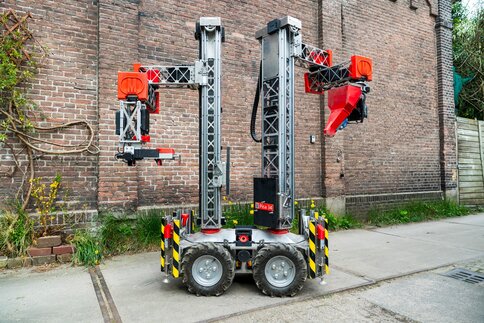
Monumental: Robots build brick facades
The Amsterdam-based startup Monumental brings autonomous robots directly to construction sites. Instead of relying on large stationary systems, the company uses a fleet of compact, electrically powered machines that transport bricks and mortar and construct masonry walls. The technology combines robotics, software and machine vision, allowing the systems to adapt to changing conditions on construction sites.
The robots are already being used in real-world projects. According to the company, they have helped build walls for more than 100 residential buildings, as well as schools and other structures. Monumental now operates more than 100 robots on construction sites in the Netherlands and the UK.
The company also aims to automate the construction of intricate brick bonds and individually designed facades. Complex patterns are planned digitally and then executed by the machines. This could significantly reduce the additional labour required for such designs. Construction companies do not need to purchase the robots themselves: Monumental offers automated masonry construction as a service.
Sitegeist: Modular Construction Robots for Concrete Repair
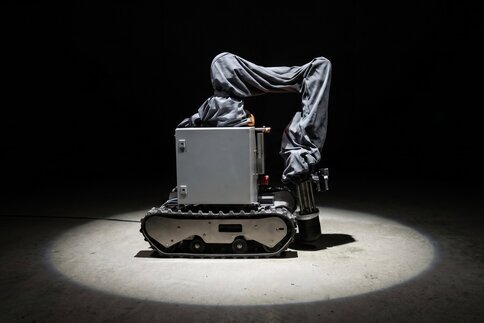
Deteriorating bridges, multi-storey car parks and tunnels often require extensive repair work. This typically involves removing damaged concrete using high-pressure water jets, a physically demanding and hazardous task. Munich-based startup Sitegeist, which emerged from robotics research at the Technical University of Munich (TUM), is developing a mobile robotic system for this purpose. It uses a water jet with a pressure of up to 3,000 bar. The tracked robot has a modular design and can be equipped with different tools. In addition to concrete removal, it is also intended to carry out sandblasting and drilling work in the future. This allows the machine to be adapted to various tasks in concrete repair.
Initial figures from prototype development show the potential time savings: according to Sitegeist, the robot removes around three cubic metres of concrete per day. By comparison, two workers can remove approximately one cubic metre using manual methods. At the same time, workers no longer have to handle the physically demanding high-pressure water jet themselves.

BAU Insider 2027: Dr Lena-Marie Pätzmann
“Robotics combines workplace safety with productivity: it reduces hazards on construction sites while improving quality and cost-effectiveness.”
Dr. Lena-Marie Pätzmann is co-founder and CEO of Sitegeist.
She is one of the brand ambassadors for BAU 2027 and supports the world's leading trade fair for architecture, materials and systems as a BAU Insider, sharing her expertise in robotics and artificial intelligence in the construction industry.
Digital product data: Simplifying life cycle assessments
Emidat: AI Automates Environmental Product Data
What are the environmental impacts of a building material throughout its entire life cycle? To answer this question, manufacturers need extensive data on raw materials, energy consumption, production and other life cycle stages. The startup Emidat is developing an AI-powered platform that automates the creation and provision of life cycle assessments (LCAs), environmental product declarations (EPDs) and digital product passports.
AI helps Emidat collect environmental data and generate documentation texts. According to the company, building material manufacturers can reduce the time and costs involved in preparing life cycle assessments (LCAs) and environmental product declarations (EPDs) by more than 70 per cent. Emidat also operates a database containing environmental information on more than 150,000 construction products. Digital interfaces allow this data to be integrated into planning and assessment software, for example. Emidat is now also developing AI agents for other data-intensive tasks in industrial companies under the concept of “AI Back Office”. The experience gained from automating environmental product data is intended to be applied to other business processes.
AI and the Circular Economy: New opportunities for reusing building materials
Optocycle: AI identifies the potential of construction waste
Whether mineral construction waste can be recycled to a high standard depends largely on its composition. Until now, this has often been estimated through a brief visual inspection upon delivery. Founded in Tübingen in 2022, the startup Optocycle takes a different approach, using optical sensors and artificial intelligence. Its systems automatically detect and classify material flows, providing data on their composition.
This gives recycling companies more accurate information about incoming construction waste. They can identify contaminants, document material quality and determine which processing methods are suitable for each material stream. The data collected can also be used to manage material logistics. According to the company, more than 30 Optocycle systems had already been installed by 2025.
Reliable material analysis is also important for the subsequent use of recycled construction materials. Recycled aggregates, for example, must meet specific quality requirements before they can be used in concrete production. Automated detection helps identify suitable material streams and document their composition.
GreyLoop: Giving Concrete Components a Second Life
GreyLoop aims to reuse concrete components from existing buildings as complete elements wherever possible, rather than crushing them during demolition and processing them into recycled materials. To achieve this, the startup is developing a digital infrastructure that makes it possible to record, assess and make suitable components available for new construction projects.
GreyLoop supports the entire process, from the initial building survey and dismantling to planning and new construction. Before demolition begins, the company assesses which concrete elements are suitable for reuse. As a specialist circular construction planner for structural works, GreyLoop then helps design teams integrate these components into new buildings. Reusing existing components eliminates the energy-intensive production of new concrete elements. According to the company, this can avoid up to 90 per cent of climate-damaging emissions compared with producing new components.

Your direct path to BAU 2027!
With just a few clicks, you can purchase your own ticket or redeem a gift certificate.