

PDF download
194023
Press release
Key theme digitalization and productivity: When digital processes are coordinated
November 26, 2026
- Digital applications should simplify processes instead of making them more difficult
- Connected planning and construction site organization unlock productivity potential
- AI and robotics increasingly finding their way into practical building construction
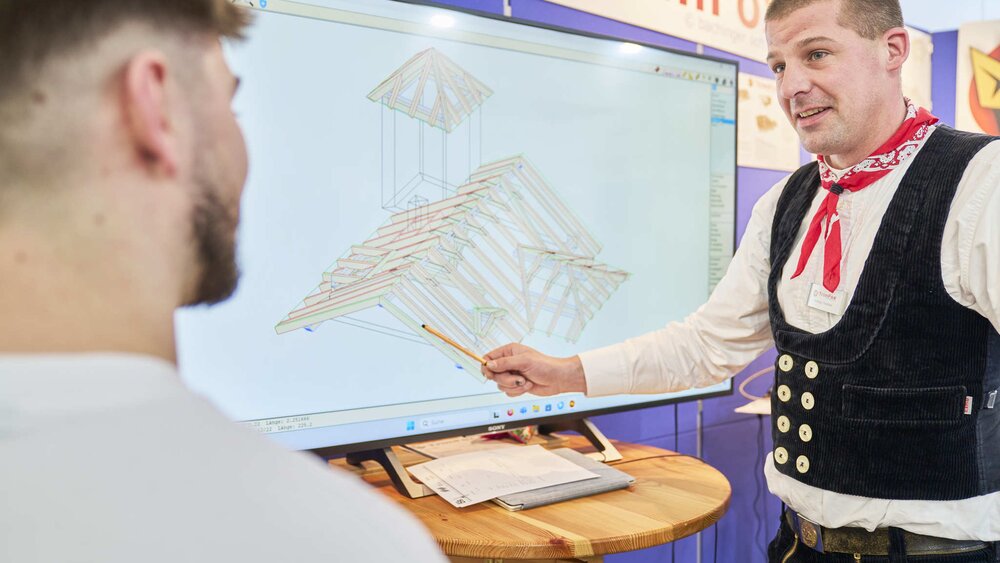
According to the European Investment Bank (EIB), labor productivity in the European construction industry has declined by 15 percent since 2000. At the same time, the industry must create more housing, renovate existing buildings, and modernize infrastructure—all while facing a shortage of personnel and growing demands. Digital technologies can make construction processes more cost-effective, but have not been exploited sufficiently to date. BAU 2027, taking place in Munich from January 11 to 15, will showcase how digital applications can be better connected and which methods are transforming construction.
The Construction Industry Transformation Barometer 2025/26, published by the German Federal Bauakademie Foundation, illustrates how challenging the adoption of digital technologies is. 53 percent of respondents cite the time-consuming nature of working with digital tools as an obstacle to resource-efficient and low-emission construction projects, while 35 percent criticize a lack of standards or incompatible interfaces.
The PwC study “The construction industry is still in transition” also reveals a significant gap between potential and implementation: 64 percent see great opportunities in BIM, but only 25 percent rate the relevant capabilities of the German construction industry as strong.
The key to more productive workflows therefore lies in connecting existing applications and making information usable across project phases. In practice, different data formats often lead to loss of information, reworking, and media disruptions. End-to-end data processes, on the other hand, can help identify planning errors sooner, simplify coordination, and manage costs and deadlines more reliably.
Manufacturers of construction products and systems also play an important role in this regard. Structured digital product data simplifies planning, tendering, life cycle assessment, and documentation. AI-powered methods are increasingly being used to help prepare environmental product information. The EIB also cites technologies such as the Internet of Things, virtual reality, and drones, which can monitor construction processes and improve coordination. To date, however, their use has focused primarily on larger companies.
More productive time at the construction site
There is also considerable productivity potential in construction. Providing materials, machine coordination, and coordinating the various trades take time. If up-to-date information on deliveries, inventories, or construction progress is missing, it results in additional waiting times and extra work.
Digital construction site management can help: If material inventories, machinery, and work progress are continuously recorded, deliveries and subsequent work can be coordinated more effectively. AI-based applications can, for example, determine material quantities based on image data, or consolidate information from different systems for the construction management.
The RICS Construction Productivity Report 2026 shows how important organization is. According to the report, the shortage of skilled workers and inadequate construction site coordination compound each other. In addition to staff availability, scheduling, sequencing, and coordination are among the key factors that influence productivity. Respondents rate employee training more highly than purely technology-related measures. It is therefore crucial to integrate digital tools effectively into existing work processes.
Automation finds its way into construction practice
Automated processes are also increasingly being used in predominantly manual tasks to date. For example, mobile robot systems can remove damaged concrete on bridges or parking garages, apply plaster, or erect masonry. According to the developers, prototypes of robot-assisted concrete repair are already achieving significantly higher removal rates than manual methods. Providers of automated plastering methods report shorter completion times and lower material consumption.
Robotics can also improve the quality of execution and relieve employees of physically demanding or hazardous tasks. Dr. Lena-Marie Pätzmann, co-founder and CEO of Sitegeist and a BAU Insider brand ambassador, therefore sees the combination of occupational safety, quality, and cost-effectiveness as a key advantage of automated construction methods.
Changing conditions at construction sites remain a challenge. Unlike stationary systems in industrial prefabrication, mobile systems need to monitor their surroundings, detect material conditions, and adjust work processes accordingly. For that, they need reliable data and clearly defined workflows.
Advancing the development and testing of such technologies requires the right framework conditions. Prof. Sigrid Brell-Cokcan from RWTH Aachen University points out that the construction industry has received little attention to date in the German government’s high-tech agenda.
With the RoboHub CR-HIVE, her team is working together with more than 120 industry experts to develop a concept for a technology ecosystem in which small and medium-sized enterprises, in particular, can test AI and robotics with limited investment risk.
New business models can also make access easier. If robot-assisted construction services are offered as a service, smaller companies do not need to purchase the corresponding technology themselves. As a result, digital technologies are increasingly changing not only building construction, but also how construction services are organized and carried out.
Productivity as a joint task
To make the construction industry more productive, digital planning, product information, construction site organization, and automated processes need to work together seamlessly. In addition to the right technology, there is a need for coordinated work processes, qualified employees, and opportunities to test new methods under realistic conditions.
BAU 2027 is addressing these developments with the key theme “Digitalization & Productivity.” Manufacturers, planners, research institutions, and stakeholders in the construction industry will demonstrate how digital technologies and new methods can make planning and construction more cost-effective. The opportunities and challenges of digitalization for the construction industry will be discussed in the accompanying forum program by, among others, Prof. Thomas Wortmann from the University of Stuttgart in his presentation “AI in architecture – a turning point?” (Friday, January 15, 10:30, Neo Stage, Hall C5, Booth 620), and Prof. Vanessa Just, Deputy Managing Director of the German AI Association, in the session “Artificial intelligence between progress and responsibility” (Friday, January 15, 11:00, Neo Stage, Hall C5, Booth 620).
Downloads
Belonging images


Felix Kirschenbauer
+49 89 949-21472
+49 89 949-21472Write an e-mail
Write an e-mail