

Building Modernization Act: More Freedom, New Questions

The draft Building Energy Act (GEG) adopted by the German government provides for far-reaching changes to the legislation. For instance, the controversial 65 per cent target for renewable energy in the installation of new heating systems has been scrapped. Instead, the government is now focusing on technology neutrality, flexible transition periods and market-based regulation.
End of the 65-percent requirement
Economics Minister Katherina Reiche described the law as an approach based on “trust, technological openness, and feasibility.” The goal, she said, is to achieve “practical climate protection for everyday life” with “less ideology and more pragmatism.” In the future, the installation of new gas and oil heating systems will in principle remain possible. The previous 65-percent rule will be replaced by a so-called “bio staircase” model. Under this system, fossil-fuel heating systems must gradually use increasing shares of climate-friendly fuels such as biomethane or hydrogen: starting at ten percent from 2029 and rising to 60 percent by 2040. At the same time, subsidies for heat pumps are to continue.
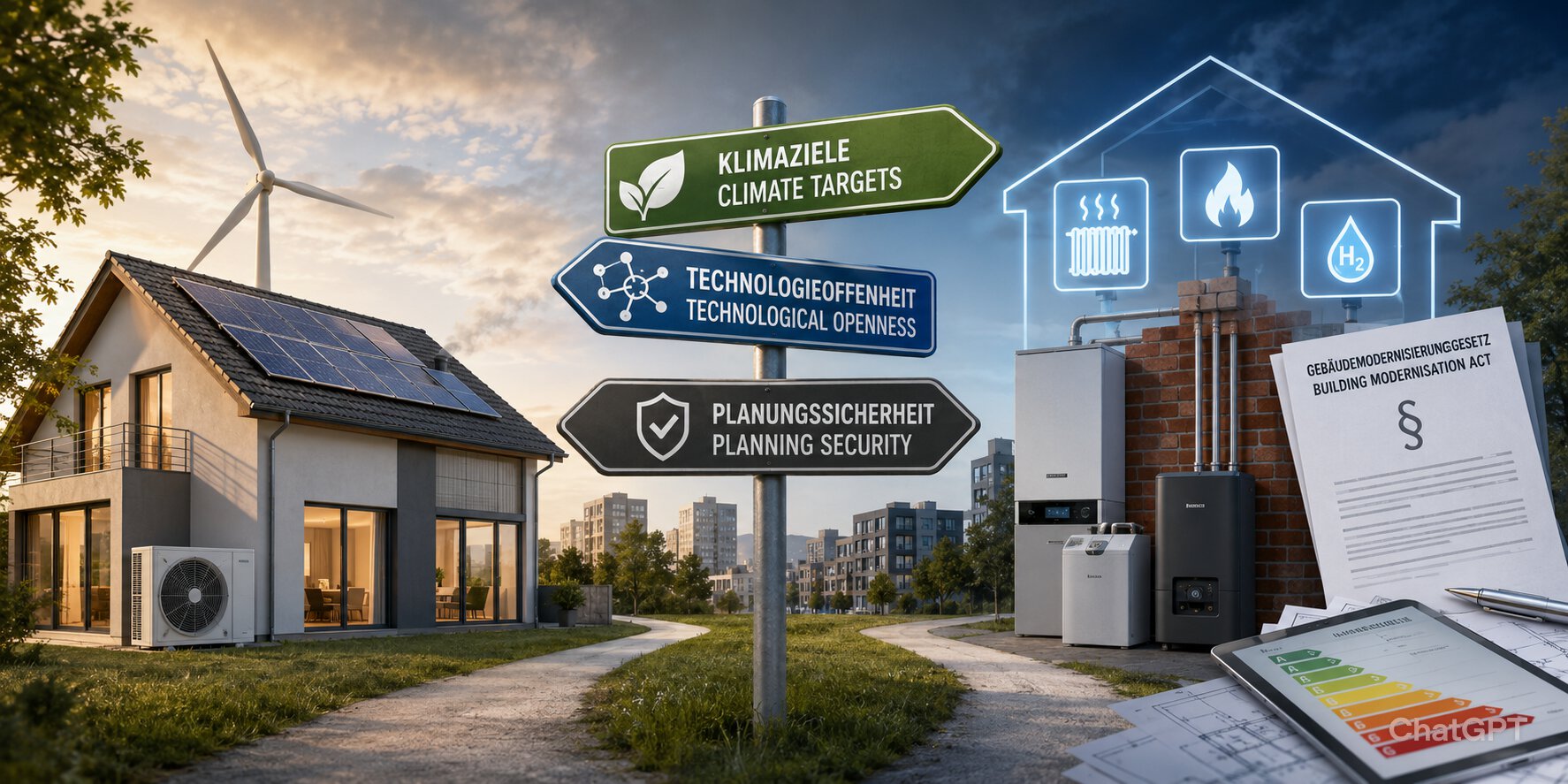
The federal government says the policy shift is intended to increase public acceptance, reduce bureaucracy, and give property owners greater freedom of choice. According to the government, many people were unsettled by the previous “Heating Act.” The new legislation is designed to respond more flexibly to different types of buildings, regional conditions, and individual solutions. However, many professional associations see new problems emerging precisely when it comes to planning certainty.

Professional associations warn of new uncertainties
The Verein Deutscher Ingenieure (VDI) warns that greater flexibility must not lead to new uncertainties. “Anyone investing today must know whether the infrastructure will still exist tomorrow,” the association explains, referring to possible gas grid dismantling and municipal heating planning. Since many heating systems operate for 20 to 30 years, today’s decisions extend far into the 2040s. The Zentralverband Sanitär Heizung Klima (ZVSHK) generally welcomes greater technological openness, but sees new risks arising from complex verification requirements and unclear prospects for climate-neutral fuels.
The Bundesarchitektenkammer (BAK) criticises above all the perceived lack of guidance for property owners. Heating decisions are long-term investments with significant financial consequences. “What is permitted is not automatically sensible,” the chamber states, calling for mandatory independent advice before replacing heating systems. Similarly, the Bundesingenieurkammer warns that the abolition of the previous 65 percent rule removes a key steering mechanism for the decarbonisation of the building sector. From the engineers’ perspective, the law lacks clear transformation pathways and reliable target benchmarks.
Controversy over hydrogen and green gases
The future role of hydrogen and so-called green gases is particularly controversial. Environmental and climate organisations doubt that these will be available in sufficient quantities and at affordable prices in the future. The Deutsche Gesellschaft für Nachhaltiges Bauen (DGNB) says the new “staircase” model is based on a “principle of hope.” Architects for Future warn of a “political extension of fossil lock-in structures.”
Criticism also comes from a legal perspective. The background is the so-called non-regression principle, derived from Article 20a of the German Basic Law. In simple terms, it raises the question of whether existing climate protection measures may be weakened if this endangers the achievement of climate targets. Reference is made, among other things, to the Federal Constitutional Court climate ruling and recent decisions by the Federal Administrative Court. At the same time, the law also contains elements that are explicitly welcomed by many professional associations. These include the implementation of the European Buildings Directive (EPBD), the introduction of zero-emission buildings, new requirements for non-residential buildings, nationwide solar obligations, and stronger consideration of life-cycle emissions and building automation.
Between Climate Targets and Technological Openness
At its core, the debate therefore revolves around the fundamental question of whether market mechanisms, carbon pricing, and technological openness are sufficient to make the building sector climate-neutral in time, or whether clear regulatory requirements are still necessary.
The draft law must first pass through the parliamentary process. How far the planned policy shift will actually go will become clear not only during this process, but above all in the coming years based on investment levels, energy prices, and the emissions data of the building sector.